

The market context
Los Angeles County is expensive, active, uneven, and highly competitive. That complexity makes timing and relevance more important for mortgage brokers, real estate agents, and title companies.
Official market pages show the split clearly. Zillow’s Los Angeles County home-value and market page reported a typical home value of $890,437, 17,189 homes for sale, 5,553 new listings, and about 20 days to pending as of April 30, 2026. Its March sales data showed 39.3% closing above list and 48.4% below list. Redfin’s Los Angeles County housing-market page reported a March 2026 median sale price of $910,000, down 1.6% year over year, with 4,251 homes sold and a 45-day average time on market. Those sources reinforce the same practical point: LA County is not one uniform market.
When a market becomes more selective, buyers research more. They compare financing, neighborhoods, payment scenarios, listings, open houses, moving questions, and transaction details before contacting a professional.
That hidden research is not a guaranteed purchase. It is a useful reason to prioritize a conversation.
What the snapshot found
Using SimplyLinked audience intelligence, we reviewed LA County intent audiences tied to mortgage research, property search, moving behavior, title activity, and new homeowner signals. The June 5, 2026 snapshot produced three approved public audience clusters:
| Audience cluster | Intent focus | Matching contacts |
|---|---|---|
| Mortgage & Financing Intent | Home loans, financing, affordability, and first-time buyer activity | 3.2K |
| Home Search & Pre-Mover Intent | Home search, open houses, listing portals, and moving behavior | 4.0K |
| Title & New Homeowner Intent | Title search, title insurance, and new homeowner activity | 3.9K |
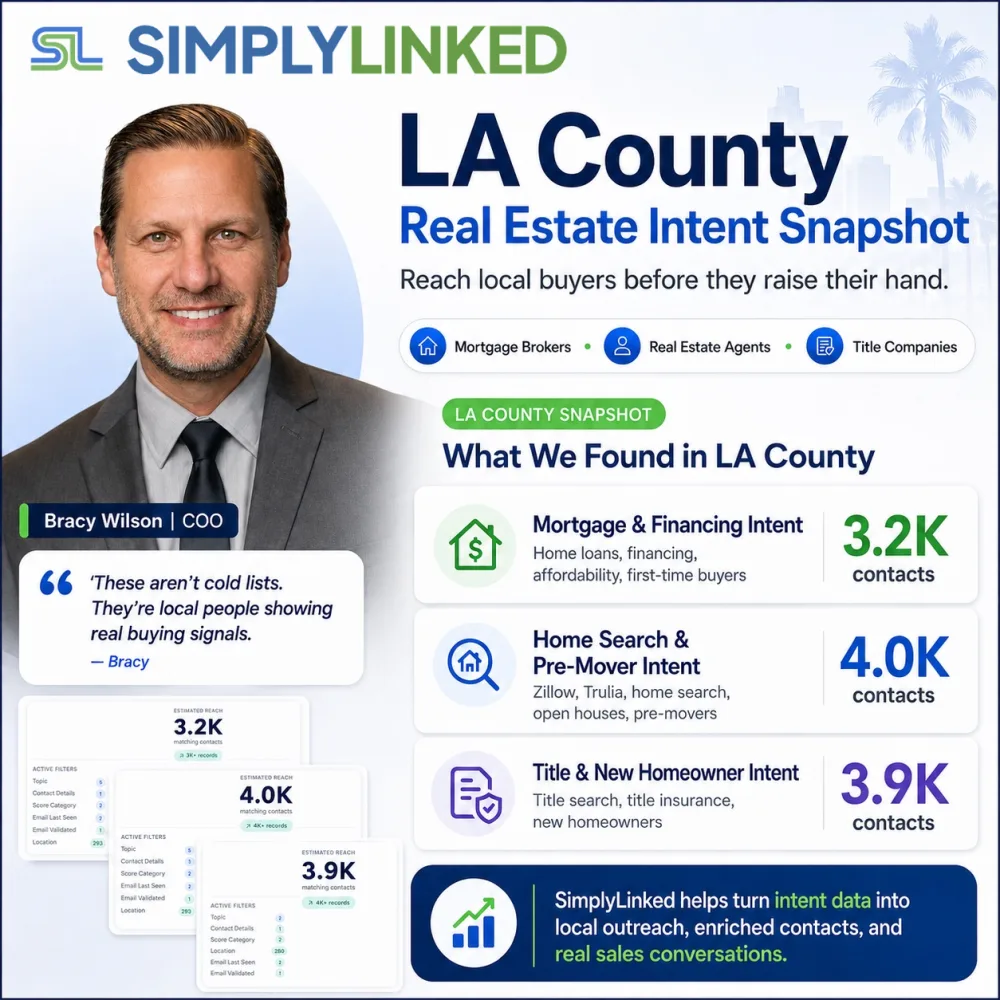 The exact approved audience counts are shown in the table and metric cards above; the image illustrates the three-cluster snapshot.
These are not three versions of the same audience. Financing research suggests a different conversation from an open-house search. New homeowner activity suggests a different application from pre-mover behavior. Treating them as one broad list would throw away the useful context.
How mortgage brokers can use the data
The Mortgage & Financing Intent audience is the affordability audience. In a high-cost market, many buyers begin with one question: Can I actually afford to buy here?
Useful campaign angles include:
- LA County affordability reviews
- First-time buyer loan-option breakdowns
- Pre-approval readiness checks
- Monthly payment planning
- Down-payment strategy conversations
- Buy-now-or-wait financing reviews
The strongest opening is not a generic mortgage pitch. It is a helpful conversation that acknowledges the buyer’s likely concern and offers a practical next step.
How real estate agents can use the data
The Home Search & Pre-Mover Intent audience reflects active market research. These people may be comparing neighborhoods, watching listings, attending open houses, or showing signs of a future move before speaking with an agent.
Useful campaign angles include:
- Neighborhood comparison guides
- Open-house strategy calls
- Buyer-representation consultations
- Current negotiation-opportunity reviews
- Pre-mover home-value conversations
- Move-up buyer planning
LA County is not one market. A buyer in Long Beach, the San Fernando Valley, or Brentwood may have a different budget, timeline, and reason to act. The audience and message should narrow with the service area.
How title companies can use the data
The Title & New Homeowner Intent audience supports transaction-related and ownership conversations, but title companies can also use the broader snapshot for partner development.
Instead of only asking agents or lenders to remember them at closing, a title company can bring useful local demand context into the relationship. Applications include:
- Agent and lender partner-development campaigns
- Buyer-education campaigns
- New-homeowner follow-up
- Investor and builder relationship campaigns
- Local market intelligence for referral partners
The point is not to turn a title company into a generic lead seller. It is to help the company bring something useful to the professionals creating and serving local demand.
LA County submarket applications
| Submarket | Market story | Practical campaign angle |
|---|---|---|
| Los Angeles City | High prices, mixed competition, and broad search activity | Buyer education, affordability, and neighborhood guidance |
| San Fernando Valley | Family homes, move-up buyers, and negotiable pockets | Pre-mover campaigns, home search, and payment planning |
| Westside | High-value transactions and selective demand | Focused buyer or seller targeting and partner campaigns |
| Pasadena / San Gabriel Valley | Established homeowners and family buyers | Move-up buyers and new-homeowner follow-up |
| Long Beach / South Bay | Coastal demand with affordability pressure | Open-house campaigns, buyer education, and payment planning |
| Antelope Valley | More accessible entry points for some LA buyers | First-time buyer and affordability campaigns |
| Burbank / Glendale | Professional households and established neighborhoods | Move-up buyer, seller valuation, and local agent outreach |
| Downtown / Central LA | Condo, investor, and renter-to-buyer activity | First-time buyer, investor, and condo-financing campaigns |
From signal to conversation
Intent data by itself does not create a sales conversation. A signal is not a closed deal, just as seeing someone browse a menu does not mean they have ordered dinner. The value is in the workflow that follows.
- Identify the relevant intent audience.
- Narrow by county, city, ZIP code, neighborhood, or service territory.
- Segment by likely buying stage.
- Enrich and verify the contact records.
- Build a message and offer that fit the signal.
- Launch and monitor relevant outreach.
- Turn useful responses into conversations.
 Signals become useful when the audience, context, message, and follow-up work together.
Where Visitor ID fits
Market intent helps surface demand across a broader audience. Visitor ID helps reveal more of the useful activity already reaching a business’s own website.
A mortgage broker may have visitors reading loan-program or affordability pages. An agent may have visitors browsing listings, neighborhood pages, or seller guides. A title company may have agents, lenders, investors, or consumers reviewing service pages without submitting a form.
Visitor ID will not identify every visitor and should not be treated as perfect surveillance. It can provide another prioritization signal for a team that already knows how it wants to follow up.
The takeaway
Not everyone in LA County is ready to buy. Thousands of people in this approved snapshot were, however, showing signals around financing, home search, moving, title, or new-homeowner topics.
The advantage is not simply having more names. It is reaching the right audience earlier with a conversation that fits the moment.