

Most businesses do not start by looking for an accounting firm
There is no single accounting buyer.
That is the useful takeaway from this Texas audience snapshot.
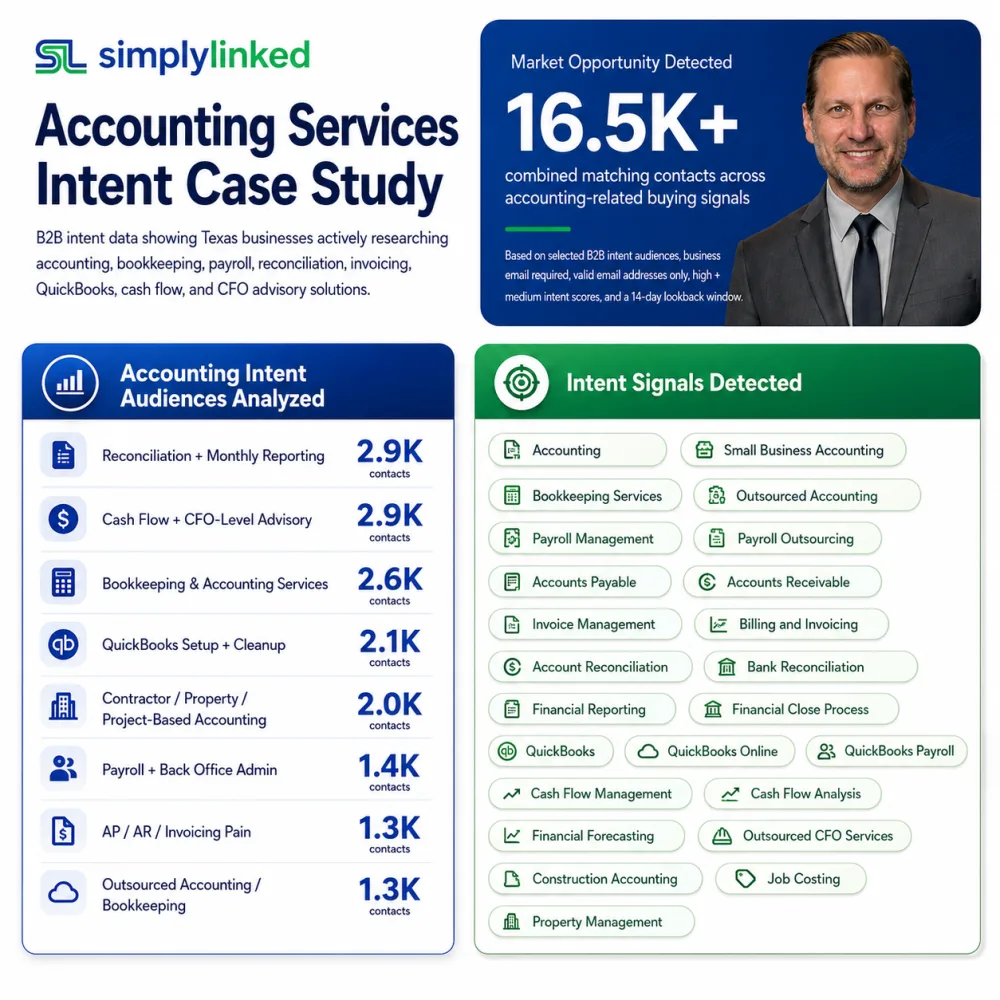
When SimplyLinked analyzed accounting-related intent activity across Texas businesses, the snapshot surfaced 16.5K+ combined matching contacts connected to real buying signals. But the more important story is not only the size of the audience. It is how the demand showed up.
It did not show up as one clean category called “accounting services.”
It showed up as reconciliation pressure. Cash flow uncertainty. Payroll drag. QuickBooks cleanup. AP and AR headaches. Invoicing issues. Reporting needs. Outsourced CFO support.
That matters because businesses usually do not begin their buying journey by saying, “We need a new accounting provider.”
They begin by saying, “Something in the financial operation is not working the way it should.”
The Small Business Administration’s guidance on managing business finances includes practical finance functions such as bookkeeping, cash flow, accounts payable, accounts receivable, reconciliation, and payroll. The IRS also gives businesses recordkeeping guidance, which reinforces why clean books and usable records matter before a business ever talks to a firm.
This snapshot is not measured client performance. It is an audience view of where accounting-related research behavior is already active.
The audience was larger than one service line
SimplyLinked’s Texas analysis surfaced multiple high-intent audience clusters tied to accounting-related research behavior.
| Audience cluster | Texas matching contacts |
|---|---|
| Reconciliation + Monthly Reporting | 2.9K |
| Cash Flow + CFO-Level Advisory | 2.9K |
| Bookkeeping & Accounting Services | 2.6K |
| QuickBooks Setup + Cleanup | 2.1K |
| Contractor / Property / Project-Based Accounting | 2.0K |
| Payroll + Back Office Admin | 1.4K |
| AP / AR / Invoicing Pain | 1.3K |
| Outsourced Accounting / Bookkeeping | 1.3K |
On paper, that looks like a list of audience buckets.
In practice, it is a map of how accounting demand forms in the real world.
Some businesses are trying to close the month cleanly. Some are trying to get visibility into cash before it becomes a bigger problem. Some are struggling with payroll and back-office processes that create operational drag. Others are dealing with systems that need cleanup before they can make confident decisions.
The opportunity is not just to target companies that might need accounting.
The opportunity is to target businesses based on the specific financial problem already shaping their search.
What the signals actually say
The intent activity in this snapshot stretched across a wide set of accounting-related topics, including:
- Accounting
- Small business accounting
- Bookkeeping services
- Outsourced accounting
- Payroll management and payroll outsourcing
- Accounts payable and accounts receivable
- Billing and invoicing
- Invoice management
- Account reconciliation and bank reconciliation
- QuickBooks and QuickBooks Online
- QuickBooks Payroll
- Cash flow management and cash flow analysis
- Financial forecasting
- Outsourced CFO services
- Construction accounting
- Job costing
- Property management accounting
That range is important.
It shows that the market is not behaving like a tidy services menu. Buyers are not neatly browsing categories one by one. They are moving through problem clusters.
A company researching QuickBooks cleanup may also be dealing with broken reporting.
A company showing cash flow analysis intent may also be approaching a need for CFO-level support.
A company looking into payroll outsourcing may really be trying to remove administrative complexity that has started slowing the business down.
This is what makes intent data useful in accounting. It does not just reveal who might buy. It helps reveal the pressure behind the buying behavior.
The hidden market truth
Most businesses do not shop for accounting first.
They shop for relief first.
That is the more useful lens for reading this snapshot.
From the outside, it can look like businesses are comparing vendors. Underneath that, many are reacting to friction they can already feel:
- Month-end reporting takes too long.
- Books are not clean enough to trust.
- Invoicing and collections create avoidable cash pressure.
- Payroll and back-office work drain time from higher-value priorities.
- Growth has outpaced the current financial setup.
- Better forecasting and decision support are needed without building a full internal finance team.
When a business starts researching one of those issues, it may not describe the search as looking for accounting services.
But the commercial opportunity is already forming.
That is exactly where this audience becomes valuable.
Why this matters for accounting firms
Many firms still market at the service-category level.
They promote bookkeeping, payroll, CFO services, reconciliations, cleanup, or reporting as static offerings. But buyers often arrive through the problem, not the category.
That creates a messaging gap.
If a prospect is showing research behavior around cash flow management, a generic full-service accounting firm message may feel too broad.
If the signal is QuickBooks setup and cleanup, the message should acknowledge disorder, cleanup, accuracy, and regaining control.
If the signal is AP, AR, or invoicing pain, the offer should connect to process clarity, collections rhythm, and operational efficiency.
If the signal is outsourced CFO services, the framing should elevate from bookkeeping to visibility, forecasting, and decision confidence.
The firms that win earlier are usually the ones that match the conversation to the pressure the buyer is already feeling.
What accounting professionals could do with this audience
This kind of Texas accounting audience gives firms several practical ways to move.
They can build segmented outbound campaigns around specific pain categories instead of using one generic message.
They can prioritize outreach based on the strength and type of intent signal.
They can create retargeting and nurture paths around bookkeeping, payroll, QuickBooks cleanup, cash flow, or CFO-level advisory themes.
They can identify where demand is strongest before investing more into broad, undifferentiated marketing.
Just as importantly, they can start conversations earlier.
Not earlier in an abstract sense. Earlier in the buyer’s actual thought process.
Earlier when the problem is active, but before the buyer has fully commoditized the search.
The strategic takeaway
This Texas snapshot points to a bigger truth about accounting demand:
The market is not one audience waiting for one message.
It is a collection of businesses experiencing different kinds of financial friction at different stages of urgency.
That is why a flat outreach approach underperforms.
When one company needs reporting cleanup, another needs payroll relief, and another needs strategic cash guidance, sending the same message to all three weakens relevance before the conversation even starts.
The better move is to let the signal shape the message.
That is where intent becomes more than data. It becomes a way to read the market with more precision.
From snapshot to acquisition system
The snapshot uncovered 16.5K+ combined matching contacts tied to active accounting-related buying signals across Texas.
But the bigger opportunity is not the count alone.
It is the clarity.
The data shows accounting demand spread across specific operational and financial pain points: reconciliation, reporting, cash flow, payroll, invoicing, QuickBooks cleanup, outsourced bookkeeping, and CFO-level support.
For accounting firms, that creates a better path to market.
Instead of treating every prospect the same, they can align outreach to the problem the buyer is already trying to solve.
And in a category built on trust, relevance, and timing, that is often what opens the conversation.