

Why timing matters in Texas real estate
Mortgage brokers, real estate agents, and title companies all depend on getting into the right conversation early. By the time someone fills out a form, they may have already compared mortgage options, browsed listings, visited open houses, researched affordability, or spoken with another professional.
Intent data helps identify audiences showing relevant research behavior before that obvious hand raise. It does not mean someone is guaranteed to buy a home. It means there may be a useful reason to prioritize and tailor a conversation.
The market context makes that timing more valuable. Realtor.com’s official housing data library tracks a market where buyers have more choices, pricing is adjusting, and activity depends heavily on whether the timing and monthly-payment math make sense.
This is not one simple statewide market. Texas buyers are researching different questions in different cities, counties, price bands, and stages of the home-buying journey.
What the Texas-wide snapshot found
Using SimplyLinked audience intelligence, we reviewed Texas-wide intent audiences tied to home buying, mortgage research, property search, moving behavior, title activity, and new-homeowner signals.
The approved audience snapshot produced three distinct clusters:
| Audience cluster | Intent focus | Texas-wide matching contacts |
|---|---|---|
| Mortgage & Financing Intent | Mortgage, home-loan, financing, affordability, and first-time buyer topics | 12.2K |
| Home Search & Pre-Mover Intent | Listing portals, home search, open houses, and pre-mover activity | 14.9K |
| Title & New Homeowner Intent | Title search, title insurance, and new-homeowner activity | 13.4K |
These are audience snapshots, not guaranteed buyers or measured campaign results. Their value is in the context: someone researching home-loan options may need a different conversation from someone browsing open houses or researching title insurance.
Statewide proof, local application
The Texas-wide view proves that measurable signal exists. Most real estate professionals, however, do not need to target the entire state.
A mortgage broker may serve Dallas-Fort Worth, Collin County, Houston, Austin, San Antonio, or a specific group of ZIP codes. An agent may focus on a defined farm area. A title company may build relationships within one referral market.
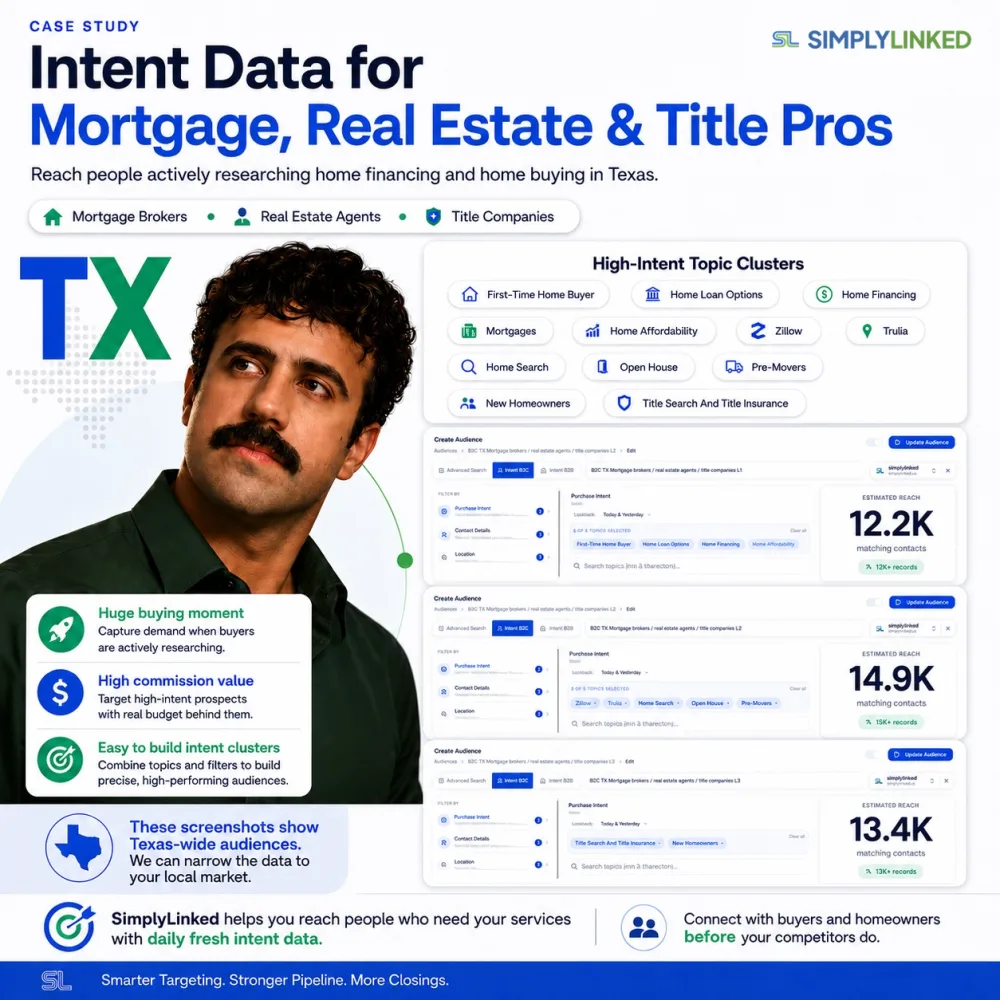 Big numbers establish opportunity. Local filters turn the opportunity into a usable campaign.
The audience can be narrowed by geography, recency, available contact information, validation status, and other practical campaign filters. That turns a broad signal pool into a market-specific decision.
Why Collin County is a useful example
Collin County illustrates why local context matters. Its fast-growing communities include McKinney, Frisco, Plano, Allen, Prosper, and Celina, but current conditions are more selective than the pandemic-era market.
Zillow’s Collin County market data reported a typical value of $491,376, down 6.3% year over year, with 5,204 homes for sale, 1,702 new listings, and 71.1% of March sales closing below list price.
That does not mean demand disappeared. It means buyers may compare more carefully, sellers have less automatic leverage, and professionals need a more relevant reason to begin a conversation.
For a Collin County mortgage broker, affordability and payment planning may be the useful opening. For an agent, it may be current negotiation opportunities or local inventory. For a title company, local buyer intelligence can support stronger lender and agent relationships.
How mortgage brokers can use the signal
Borrowers often begin with questions rather than a search for a specific mortgage broker:
- Can I afford to buy in this market?
- What could my monthly payment look like?
- Which loan options fit my situation?
- Should I get pre-approved now or wait?
- Does a softer price actually improve affordability?
Those questions create useful intent signals. A broker can use the signal to prioritize an audience, then lead with a normal, helpful offer such as an affordability review, loan-option breakdown, or pre-approval readiness conversation.
The signal belongs behind the scenes. The message should still sound human.
How real estate agents can use the signal
Buyers and sellers are online long before they speak with an agent. They browse listings, compare neighborhoods, watch price changes, look at open houses, and decide whether the timing feels right.
Useful campaign angles include:
- First-time buyer education
- Local inventory and negotiation guidance
- Open-house strategy
- Neighborhood comparisons
- Buyer representation
- Pre-mover and home-value conversations
Someone researching affordability needs a different conversation from someone actively watching open houses. Better segmentation makes the outreach more relevant.
How title companies can use the signal
Title companies are often positioned late in a transaction, but they can use audience intelligence earlier for partner development.
Consumer activity around title, new-homeowner, financing, and home-search topics can help a title company bring useful local demand context to agents, lenders, builders, and investor partners. Instead of only asking for the next closing, the company can help partners understand and reach local buyer activity.
That shifts the conversation from vendor availability to practical growth support.
 Each professional serves a different part of the journey, but all three benefit from better timing and context.
Match the market, signal, and message
Texas markets should not receive one generic campaign:
| Market example | Useful market framing | Potential conversation |
|---|---|---|
| Collin County | Buyers have more time and negotiating room than during the rush | Affordability, payment planning, and local opportunity |
| Austin | Buyers are watching a major correction market carefully | Timing, negotiation, and buyer education |
| Dallas and San Antonio | Price cuts can create opportunity and uncertainty | Local guidance and what concessions mean for a buyer |
| Houston | Affordability remains relative once taxes, insurance, and payments are considered | Financing clarity and focused home-search support |
The audience signal helps decide who may deserve attention. Local market context helps decide what may be useful to say.
Where Visitor ID fits
Market intent helps identify demand across a broader audience. Visitor ID helps reveal more of the useful activity already reaching a business’s own website.
A mortgage broker may have visitors reading loan-program or affordability pages. An agent may have visitors browsing listings and neighborhood guides. A title company may have professionals reviewing service pages without submitting a form.
Visitor ID will not identify every visitor. It can add another prioritization signal for a team prepared to follow up responsibly.
From audience snapshot to acquisition system
An audience snapshot is not a finished campaign. It is closer to a radar screen: it helps show where activity exists, but a team still needs to decide where to go and how to approach.
The practical workflow is:
- Choose the market and conversation the campaign should create.
- Select the relevant intent cluster.
- Narrow the audience to the actual service territory.
- Enrich and verify available contact data.
- Build a useful offer and message for the market.
- Launch, monitor, and route replies into real conversations.
The takeaway
The approved Texas-wide audience counts show measurable activity across financing, home search, moving, title, and new-homeowner topics. The opportunity is not to market blindly to the entire state.
It is to narrow the signal into the right local market, match the message to the likely buying stage, and begin a more useful conversation before the obvious hand raise.