
The buyer is already planning before they raise their hand
A wedding business rarely meets the buyer at the very beginning.
Long before a consultation request comes in, couples and event buyers may already be researching planners, comparing decor ideas, looking at venues, thinking about photography, reviewing attire, and trying to figure out what kind of help they actually need. By the time they raise their hand, they may already have a shortlist, a budget concern, or a specific vision in mind.
That early research creates a useful window.
In this Dallas County audience snapshot, SimplyLinked found a combined reach of 19.8K across five distinct wedding and event-related intent segments in a two-day period. These audiences were filtered to Dallas County, required email availability, and included valid-address criteria with high and medium intent scores.
This is not a list of booked events. It is not a list of guaranteed buyers. It is a view into where relevant market attention already exists.
What the Dallas County snapshot found
The audience snapshot surfaced five distinct segments:
| Audience segment | Matching reach | Signals included |
|---|---|---|
| Wedding Planning Audience | 2.1K | Wedding planning, hiring a wedding planner or coordinator, wedding reception details, and coordinating with wedding vendors |
| Wedding Design & Decor Audience | 4.1K | Wedding theme and decor, wedding stationery, wedding cake, and wedding favors |
| Engaged & Pre-Wedding Audience | 2.1K | Engagement photography, wedding websites, wedding attire, and wedding registries |
| Destination & Premium Wedding Audience | 2.6K | Destination wedding planning, wedding insurance, preserving wedding memories, and handling wedding-day emergencies |
| Event Planning Audience | 8.9K | Event planning, event photography, surprise or special-event planning, venue selection, and catering and menu planning |
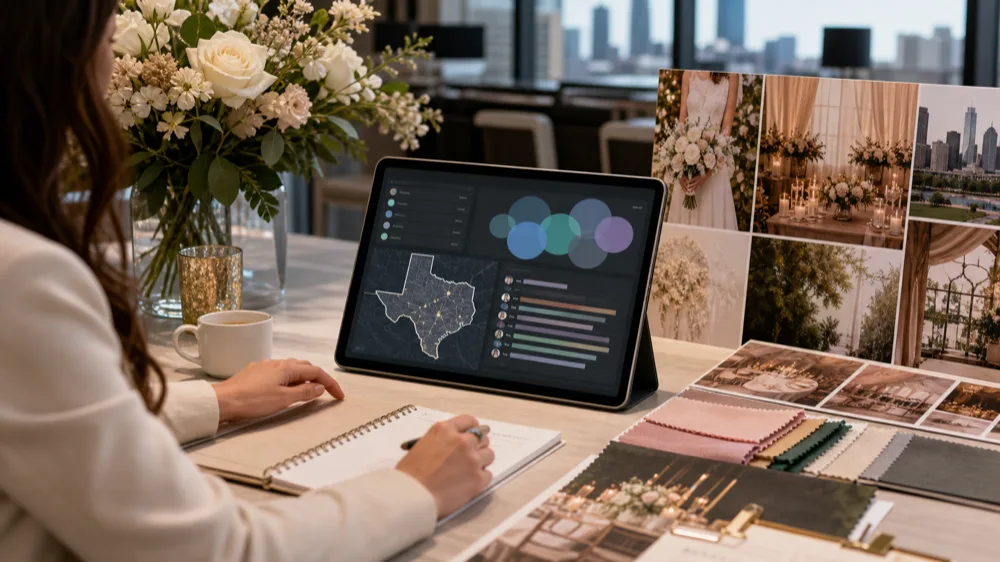
 The approved audience counts are listed in the table and metric cards; this image illustrates how different intent clusters support different campaign decisions.
The combined reach may include overlap across segments. That is normal in a category like weddings, where one buyer may move between planning, design, photography, venue, and event-related research in a short period of time.
The buyer is not just looking for a planner
People do not usually begin with, “I need to hire a wedding planner today.”
They begin with questions:
- How do we make this feel organized?
- What will this actually cost?
- Which vendors do we need first?
- How do we make the event feel like us?
- What should we handle now so we are not stressed later?
That matters because the strongest campaign does not start with a generic pitch. It starts with the decision the buyer is already trying to make.
Five audiences require five different conversations
Wedding planning audience
The 2.1K wedding planning segment appears closest to practical coordination decisions.
These are people researching the mechanics of the event: the plan, the timeline, the vendors, and the logistics. They may be asking whether they need a planner, a coordinator, or a more specialized support package.
Useful campaign angles for this audience include a wedding planning checklist, a month-of coordination guide, a vendor management overview, or a “what a planner actually handles” breakdown.
This group is not just buying help. They are looking for relief from complexity.
Wedding design and decor audience
The 4.1K design and decor segment is larger and more visually driven.
These buyers are thinking about how the event will look and feel. Their research suggests a desire for cohesion, taste, personalization, and clear creative direction. In many cases, the emotional driver is not simply decoration. It is confidence that the event will feel beautiful, intentional, and memorable.
Useful offers here include decor planning guides, style lookbooks, mood-board consultations, color-palette planning, or design package comparisons.
For this audience, the message should feel inspiring without becoming vague. They want vision, but they also want someone who can execute it.
Engaged and pre-wedding audience
The 2.1K engaged and pre-wedding segment likely reflects early-stage buyers.
Signals such as engagement photography, wedding websites, attire, and registries suggest people who are entering the planning cycle or organizing their next steps. They may not be ready for a full planning commitment yet, but they are actively building momentum.
This is a strong audience for educational content: what to do in the first 30 days after getting engaged, vendor priority checklists, planning timelines, or a consultation offer built around getting organized early.
The opportunity here is not pressure. It is guidance.
Destination and premium wedding audience
The 2.6K destination and premium segment points to a higher-complexity conversation.
Destination weddings and premium events usually carry more moving parts, more vendor coordination, more travel considerations, and greater pressure to avoid mistakes. Signals around insurance, preserving memories, and day-of emergencies suggest an audience thinking beyond aesthetics and into risk, protection, and execution.
That makes this segment especially useful for higher-touch planning packages, concierge-style support, or premium coordination offers.
The best message for this audience is not just elegance. It is calm authority.
Event planning audience
At 8.9K, the event planning audience is the largest segment in the snapshot.
This is broader than weddings alone, but that is exactly why it matters. It represents a larger pool of people researching venues, photography, catering, and event logistics. Some may be planning engagement parties, bridal showers, rehearsal events, milestone celebrations, or other special gatherings that connect naturally to the wedding journey.
For a wedding business, this segment can support adjacent-offer positioning, nurture campaigns, and broader local visibility.
It is also a reminder that the wedding buyer does not always enter through a “wedding planner” keyword. Sometimes they enter through a venue question, a catering decision, or an event photography need.
Why this matters for Dallas-Fort Worth wedding businesses
A business that waits only for inbound form fills is often entering the conversation late. A business that understands which audience is researching now can shape a more relevant offer earlier.
The practical advantage is not blasting the same message to everyone.
It is separating the audience by likely decision stage and matching each group with the next most useful conversation.
A buyer researching wedding decor should not receive the same message as someone researching destination wedding logistics. Someone exploring engagement photography is in a different moment from someone actively comparing coordinators.
The signal helps define the moment. The message still has to fit it.
From audience snapshot to campaign plan
A practical workflow for a Dallas-Fort Worth wedding business could look like this:
- Start with the audience segment that best matches the service being sold.
- Narrow geography to the ZIP codes or service area that matter most.
- Separate higher-intent outreach from earlier-stage nurture.
- Match each segment to one clear offer, not one generic sales pitch.
- Use email and retargeting to begin the conversation before competitors do.
- Route replies into consultations, planning calls, or tailored follow-up.
 Audience signals become useful when they are paired with segmentation, offer strategy, outreach, and follow-up.
That turns a broad signal pool into a campaign that feels timely and relevant instead of random.
What this snapshot does and does not show
This snapshot shows recent audience activity tied to wedding and event-related research in Dallas County over a two-day period.
It does not show confirmed bookings, measured campaign performance, closed revenue, or guaranteed purchase intent.
It should be used as a prioritization tool.
In other words, it helps answer: where is the attention, which segment looks most usable, and what kind of conversation should happen first?
The takeaway
The most important insight in this snapshot is not just the 19.8K combined audience reach.
It is the shape of the demand.
Wedding planning demand in Dallas County is not one uniform audience. It is made up of people solving different problems at different moments: planning, design, engagement-stage organization, premium coordination, and broader event execution.
The businesses that win earlier are usually not the ones shouting the loudest.
They are the ones that recognize what the buyer is already trying to solve and respond with something that feels useful, timely, and specific.